Wels catfish fishing with the clonk
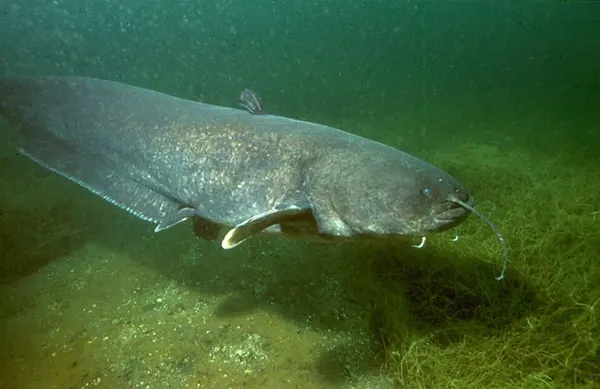
The clonk is a wooden or metal tool you strike the surface of the water with: the deep “clonk” sound draws the catfish up from the depths and makes it curious. You fish from a boat, with the rig lowered vertically beneath it.
It's an old technique, typical of the Danube and the big rivers. Wels catfish can reach tens of kilos, so the gear has to be very strong.
Species: Wels catfish
What you need
- Rod: short and powerful, 1.8-2.4 m, for the vertical rig.
- Reel: large, with a powerful drag, or a multiplier.
- Line: 0.40-0.55 mm braid.
- Rig: a 60-200 g lead, a strong 1-1.5 m hooklength and a large hook, 4/0-8/0.
- Boat and safety: a stable boat, a life jacket, a head torch and a glove for landing the catfish by the jaw.
Baits
- Big bunches of worms, and leeches.
- Baitfish, where allowed.
- Large soft lures, rigged for vertical fishing.
When to fish
- Summer and early autumn, when the water is warm; activity drops as the water cools.
- Early morning and evening, in warm, settled weather.
Where are you fishing
- The Danube and its arms, the big rivers and the large reservoirs.
- Deep holes and their edges, steep banks, groynes and trees fallen into the water.
Step by step
- 1
Choose the hole. Find a deep stretch and let the boat drift slowly over it, or anchor upstream of it.
- 2
Lower the rig. Lower the rig vertically to the bottom, then raise it 1-3 m: the bait sits between the bottom and mid-water.
- 3
Strike the water with the clonk. Hit the water in series of 3-5 strokes, with pauses; with your other hand, hold the rod and feel the line.
- 4
Work the bait. Gently raise and lower the bait; the catfish comes towards the sound and usually strikes between series.
- 5
Strike. On a bite, let the catfish pull for a moment, then strike firmly.
- 6
Playing the fish. The fight can last a long time: keep the rod up with the drag set, and grab the catfish by the lower jaw, with the glove, only once it's tired.
Common mistakes
- Striking the water too often and too hard, which scares the fish instead of drawing them in.
- Gear too weak for a fish weighing tens of kilos.
- Drag screwed down all the way: the line snaps on the first run.
- Fishing from a boat without a life jacket.
Rules on natural waters
Wels catfish
Minimum size: 50 cm
Species closed season: none, only the general closed season
General closed season: 9 April - 7 June (the periods differ on border waters and in the Danube Delta)
Daily limit: At most 5 kg of fish per day, or a single fish if it's over 5 kg.
The rules above are for natural waters (rivers, lakes, the Danube), where you also need a permit. On a private lake the lake's rules apply: many are catch & release or have their own limits.
For information only, not guaranteed legal advice. There are many local exceptions (Danube Delta, border waters, catch-and-release sections) not covered here. Always check the official ANADSPA (formerly ANPA) source before fishing.
Frequently asked questions
Can I fish for wels catfish from the bank too?
Yes, by ledgering: natural bait, a heavy lead and a catfish float that keeps the bait off the bottom. The rig is described step by step in the rigs guide.
What matters more with the clonk: the sound or the bait?
The sound brings the catfish in, and the bait has to be at exactly its depth; change the depth until you find the layer where it strikes.
What is the minimum size for wels catfish, and when is the closed season?
In natural waters, the legal minimum size is 50 cm; smaller fish must be released. The general closed season also applies on natural waters: 9 April - 7 June.
Step-by-step guides
- Rig guide: Catfish ledgering (fixed rig with a heavy lead)
- Releasing fish properly: Wels catfish
Fishing for wels catfish by county
Find where to fish in the RoFish app
The map of fishing lakes and public waters across the country, the species filter, the rules of every spot and “Am I allowed to fish?” for the day you pick are in the RoFish app, on your phone.