Carp fishing with boilies on a hair rig
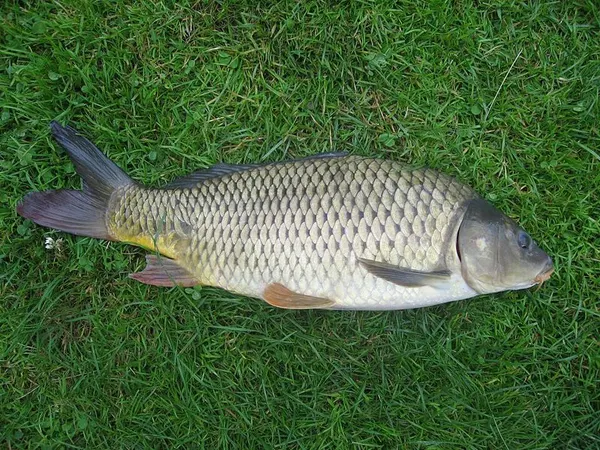
When carp fishing with boilies, the bait doesn't go on the hook but on a short length of line below it, the “hair” (hair rig). The carp sucks in the boilie, the bare hook turns in its mouth and sets itself against the weight of the lead.
The rods sit on rests with bite alarms, sometimes for days on end. Choosing the spot and baiting up matter more than the bait itself: carp come where they regularly find food.
Species: Carp
What you need
- Rods: 2-3 carp rods, 3.6 m, with a test curve of 2.75-3.5 lb.
- Reels: size 6000-10000, with a free-spool system (baitrunner) or a big spool.
- Line: 0.30-0.35 mm monofilament; for long casts with heavy leads, a thicker length of line at the front (shock leader).
- Rig: a safety clip with an 80-120 g lead, an anti-tangle tube or leadcore, a 15-25 cm braided hooklength and a size 4-8 hook.
- Accessories: rod rests or a rod pod, bite alarms with swingers, a big landing net, an unhooking mat and antiseptic for the hook wound.
Baits
- 15-24 mm boilies, bottom baits or floating ones (pop-ups).
- “Snowman”: a bottom-bait boilie with a small pop-up on top, so the bait sits balanced.
- For baiting up: boilies, pellets and properly cooked particles (corn, hemp).
When to fish
- From spring until late autumn; on natural waters, after the closed season.
- The peaks are late spring and autumn, when carp feed heavily before winter.
- Night and early morning are often the best times; settled weather and a warm wind help.
Where are you fishing
- Large lakes, private fisheries, reservoirs and arms of the Danube.
- Feeding areas: the edge of the reeds, plateaus, the slope near the bank, spots with mussels.
- A firm, clean bottom: there the lead “thumps” down on contact and the bait can be seen.
Step by step
- 1
Find the features. With a rod and a marker lead, find out the depth and the type of bottom; look for a firm bottom, where you feel a sharp knock on contact.
- 2
Measure the distance. Put the line in the reel's line clip at the distance you found and note it down (with distance sticks, for example), so you can return to exactly that spot.
- 3
Bait up. With a catapult, a spod or a baiting spoon, around the spot; less at first, more once the bites start.
- 4
Prepare the rig. Thread the boilie onto the hair with a baiting needle and a stop; pull the hooklength across your palm: the hook should turn and catch.
- 5
Cast and set up. Cast to the clip, let the lead settle on the bottom, tighten the line slightly, put the rod on the rest, attach the swinger and engage the free-spool.
- 6
Playing the fish. When the alarm sounds continuously, disengage the free-spool, lift the rod and play the fish without rushing; keep the fish on the wet mat, not on the ground.
Common mistakes
- A hooklength that tangles on the cast: use an anti-tangle tube or a PVA bag on the hook.
- A safety clip set too tight: if the line breaks, the fish stays tethered to the lead.
- Too much feed in cold water.
- Carp laid on dry ground or kept out of the water for too long.
- Moving swims too often: carp need time to find the feed.
Rules on natural waters
Carp
Minimum size: 35 cm
Species closed season: none, only the general closed season
General closed season: 9 April - 7 June (the periods differ on border waters and in the Danube Delta)
Daily limit: At most 5 kg of fish per day, or a single fish if it's over 5 kg.
The rules above are for natural waters (rivers, lakes, the Danube), where you also need a permit. On a private lake the lake's rules apply: many are catch & release or have their own limits.
For information only, not guaranteed legal advice. There are many local exceptions (Danube Delta, border waters, catch-and-release sections) not covered here. Always check the official ANADSPA (formerly ANPA) source before fishing.
Frequently asked questions
What size boilies should I use?
15-20 mm in general; 20-24 mm where there are lots of small fish that “strip” the bait off the hair.
Can I fish for carp at night?
On private fisheries it depends on the rules. In the RoFish app you can see, for each fishery, whether night fishing is allowed, plus its rules on keeping fish.
What's a pop-up?
A boilie that floats: it sits raised above the bottom, so it's easy to see on silt or among plant debris.
What is the minimum size for carp, and when is the closed season?
In natural waters, the legal minimum size is 35 cm; smaller fish must be released. The general closed season also applies on natural waters: 9 April - 7 June.
Step-by-step guides
- Rig guide: Carp hair rig (lead on a safety clip)
- Fishing knots: Knotless knot + hair rig
- Groundbait and recipes: Homemade boilies (basic recipe)
- Groundbait and recipes: Particles: prepared maize and hemp
- Releasing fish properly: Carp and grass carp
Fishing for carp by county
Find where to fish in the RoFish app
The map of fishing lakes and public waters across the country, the species filter, the rules of every spot and “Am I allowed to fish?” for the day you pick are in the RoFish app, on your phone.