Feeder fishing: a beginner's guide
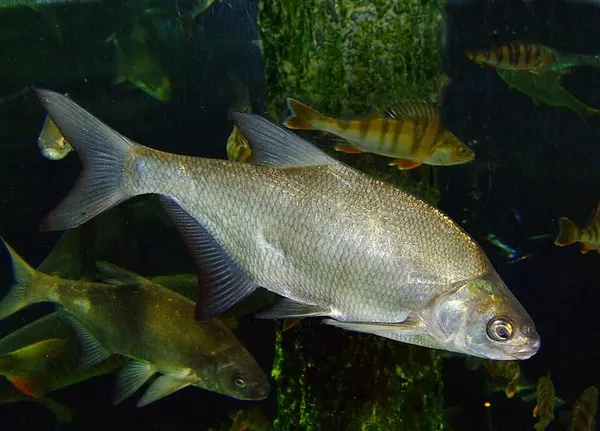
Feeder fishing is bottom fishing with a long rod with a sensitive tip (quivertip) and a feeder full of groundbait that puts the food right next to the hook. You see the bite on the rod tip, not on a float.
It's the most widely used technique for bream, Prussian carp and small carp, on lakes, ponds and slow rivers. It's quick to learn, and a good session depends mostly on accuracy: the same distance on every cast, and a little groundbait, often.
Species: Bream · Prussian carp · Carp
What you need
- Rod: a 3.3-3.9 m feeder rod with 2-3 interchangeable tips; for small ponds and short distances, a 2.7-3 m picker.
- Reel: size 3000-4000, with a smooth drag and a fast retrieve.
- Line: 0.18-0.22 mm monofilament; at long range, 0.08-0.10 mm braid with a thicker length of line at the front (shock leader).
- Rig: a paternoster loop or anti-tangle tube, a 20-60 g feeder, a 40-80 cm hooklength of 0.12-0.16 mm and a size 10-16 hook.
- Accessories: a rod rest with a front bar, the reel's line clip for distance, a landing net, and a keepnet only where you're allowed to keep fish.
Baits
- Maggots (fly larvae) and small worms: the most reliable baits for bream.
- Sweetcorn, small pellets and paste: for Prussian carp and carp.
- Dampened feeder groundbait with particles mixed in (corn, maggots, pellets), so the fish find in the groundbait the same thing that's on the hook.
When to fish
- From spring until late autumn; on natural waters, after the closed season.
- The best times are early morning and evening; on scorching days, the fish bite better when it's cooler.
- It works in winter too, on ice-free water: very little groundbait, a longer, finer hooklength and small baits.
Where are you fishing
- Lakes and ponds with a firm silt or sandy bottom, 15-50 m from the bank.
- The edge of a hole or the drop-off from shallow to deep water: fish patrol here looking for food.
- On rivers: slow-flowing stretches, after a bend or behind a weir, with a heavier feeder.
Step by step
- 1
Read the bottom. Cast an empty feeder and count the seconds until it hits the bottom; drag it back slowly and feel whether it's silt, sand or gravel.
- 2
Set the distance. After a good cast, put the line in the reel's line clip so that every cast lands in the same spot.
- 3
Feed the swim. To start, make 6-10 quick casts with a full feeder, emptying it on the bottom with a short jerk: that's how you build a patch of groundbait.
- 4
Put the rod on the rest. Bait up, cast to the clip, then set the rod with its tip at a right angle to the line and tighten the line until the tip bends slightly.
- 5
Watch the tip. Small trembles are fish brushing the groundbait; a clear pull or a sudden straightening of the tip is the bite. Lift the rod firmly, without jerking.
- 6
Recast often. Refill and recast every 3-5 minutes, even without bites, until the fish gather; after that, the bites set the pace.
Common mistakes
- Groundbait packed too tightly into the feeder: it doesn't break up on the bottom and the swim stays empty.
- Casting to different distances: the groundbait gets scattered and the fish don't stay in one place.
- A tip that's too stiff (you can't see the delicate bites) or too soft for wind and current (it bends on its own).
- A hooklength that's too thick or a hook that's too big for bream and Prussian carp.
- Too much groundbait in cold water, when the fish are eating little.
Rules on natural waters
Bream
Minimum size: 25 cm
Species closed season: none, only the general closed season
Prussian carp
Minimum size: 15 cm
Species closed season: none, only the general closed season
Carp
Minimum size: 35 cm
Species closed season: none, only the general closed season
General closed season: 9 April - 7 June (the periods differ on border waters and in the Danube Delta)
Daily limit: At most 5 kg of fish per day, or a single fish if it's over 5 kg.
The rules above are for natural waters (rivers, lakes, the Danube), where you also need a permit. On a private lake the lake's rules apply: many are catch & release or have their own limits.
For information only, not guaranteed legal advice. There are many local exceptions (Danube Delta, border waters, catch-and-release sections) not covered here. Always check the official ANADSPA (formerly ANPA) source before fishing.
Frequently asked questions
What's the difference between the feeder and the method feeder?
With the classic feeder, the hooklength is long and the bait lies next to the little pile of groundbait; with the method, the bait is pressed into the groundbait on the feeder, on a short hooklength, and the fish hooks itself. The method is simpler for carp and Prussian carp; the classic feeder is more sensitive for bream.
What feeder weight should I use?
The lightest one that stays put: 20-40 g on a lake close to the bank, 40-60 g at distance, and 60-120 g on a river, depending on the current.
How long should the hooklength be?
40-80 cm on a lake; when the fish are wary or the water is cold, lengthen it up to 1 m. In current, shorten it to 30-50 cm.
What is the minimum size for bream, and when is the closed season?
In natural waters, the legal minimum size is 25 cm; smaller fish must be released. The general closed season also applies on natural waters: 9 April - 7 June.
Step-by-step guides
- Rig guide: Feeder with anti-tangle sleeve / loop (paternoster)
- Groundbait and recipes: All-round feeder groundbait (bream, Prussian carp)
- Fishing knots: Figure 8 loop (double loop)
Fishing for bream by county
Find where to fish in the RoFish app
The map of fishing lakes and public waters across the country, the species filter, the rules of every spot and “Am I allowed to fish?” for the day you pick are in the RoFish app, on your phone.