Fly fishing: a beginner's guide
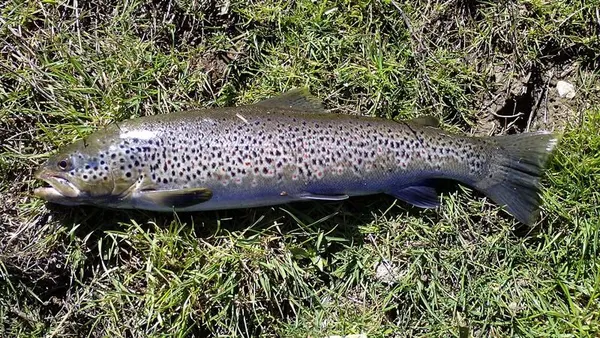
In fly fishing, the bait weighs almost nothing: it's an artificial fly made of feathers and thread. You cast with the weight of the line, a thick, heavy fly line that carries the fine leader and the fly behind it.
It's the classic technique for trout on mountain rivers, where salmonids may only be fished with artificial lures, but it also works for chub on hill rivers. It's harder to learn than spinning, but very effective when the fish are feeding on insects.
Species: Brown trout · Rainbow trout · Brook trout · Chub
What you need
- Rod: a 2.4-2.75 m (8-9 ft) fly rod, AFTM class 3-5, for mountain rivers.
- Reel: a fly reel matched to the rod's class; it holds the line and the backing, and with small trout the drag matters little.
- Line: a floating fly line in the same AFTM class as the rod: the heavy line is what does the casting.
- Hooklength: a 2.7-3.6 m (9-12 ft) tapered leader, with a 0.10-0.16 mm tip (tippet), to which you tie the fly.
- Accessories: waders or thigh boots, a vest with pockets, polarised glasses, a small landing net, forceps and a fly box.
Baits
- Dry flies, which float and imitate adult insects: the most beautiful to fish, when the fish are rising to the surface.
- Nymphs, which imitate larvae and fish on or near the bottom: they catch most often, all season.
- Streamers, which imitate small fish, for big trout and for high or coloured water.
- On mountain waters, no more than 3 flies per rig.
When to fish
- On natural waters, the season opens after the trout closed season; see the periods below.
- Mornings and evenings, when insects hatch from the water; on warm, overcast days, all day.
- In summer, at midday, with nymphs, in fast, shaded water.
Where are you fishing
- Mountain and hill rivers and streams, with cold, clear water.
- The head of a pool, where fast water runs into slow water, behind stones, along the edge of the current and under undercut banks.
- On the catch & release stretches in the annual closed-season order (for example on the upper Râul Doamnei or on part of the Bistrița Aurie), all fish are released.
- On waters managed by the Forestry Directorates (Romsilva) or by associations, you need their permit as well as the ANADSPA (formerly ANPA) permit.
Step by step
- 1
Learn the basic cast. Hold the line under your index finger, lift the rod back to almost vertical (1 o'clock), wait for the line to straighten behind you, then bring the rod forward to 10 o'clock and stop it sharply.
- 2
Practise on grass. Make your first casts on a lawn, without a hook: you learn the rhythm without snagging trees or spooking fish.
- 3
Read the water. Look for rings on the surface (fish taking insects) and places where the current brings food: that's where you put the fly.
- 4
Fish the dry fly. Cast upstream, above the fish, and let the fly float freely with the current, without the line dragging it; gather in line as it comes towards you.
- 5
Fish the nymph. Cast upstream and let the nymph sink towards the bottom; watch the end of the line or an indicator: any stop or twitch is a take.
- 6
Strike and play the fish. At the take, lift the rod sharply, trap the line under your finger and bring the fish in by stripping line by hand; let a big fish take line off the reel.
- 7
Release it properly. If you release it, wet your hands, keep it in the water and remove the hook quickly with pliers.
Common mistakes
- Casting too hard, taking the rod too far back: the line collapses in a heap.
- The fly dragged across the surface by the line, which trout refuse.
- A leader that's too thick for clear water.
- Noise and shadows on the bank: the trout bolt before your first cast.
- Flies that are too big and don't look like the insects on the water.
Rules on natural waters
Brown trout, Rainbow trout, Brook trout
Minimum size: 20 cm
Species closed season: 1 October - 31 March
Chub
Minimum size: 25 cm
Species closed season: none, only the general closed season
General closed season: 9 April - 7 June (the periods differ on border waters and in the Danube Delta)
Daily limit: In mountain waters: at most 10 salmonids per day in total.
The rules above are for natural waters (rivers, lakes, the Danube), where you also need a permit. On a private lake the lake's rules apply: many are catch & release or have their own limits.
For information only, not guaranteed legal advice. There are many local exceptions (Danube Delta, border waters, catch-and-release sections) not covered here. Always check the official ANADSPA (formerly ANPA) source before fishing.
Frequently asked questions
What rod class should I start with?
For our mountain rivers, a 2.7 m (9 ft) rod, class 4 or 5, with a floating line of the same class, is the most versatile.
Dry fly or nymph?
The dry fly when you see fish rising to the surface; the nymph the rest of the time, because fish feed mostly below the surface. Beginners usually catch more on the nymph.
Can I fly fish for anything other than trout?
Yes: chub and nase take flies and nymphs well on hill rivers, and on lakes streamers work for perch and even pike, with a suitable trace.
What is the minimum size for brown trout, and when is the closed season?
In natural waters, the legal minimum size is 20 cm; smaller fish must be released. It has its own closed season: 1 October - 31 March. The general closed season also applies on natural waters: 9 April - 7 June.
Step-by-step guides
- Fishing knots: Improved clinch
- Fishing knots: Surgeon's knot
- Releasing fish properly: Trout and grayling
Fishing for brown trout by county
Find where to fish in the RoFish app
The map of fishing lakes and public waters across the country, the species filter, the rules of every spot and “Am I allowed to fish?” for the day you pick are in the RoFish app, on your phone.
Other fishing techniques
- Trout on spinners
- Spinning for chub
- Feeder fishing
- Carp on the method feeder
- Carp on boilies
- Spinning for pike
- Zander on the jig
- Perch on the micro-jig
- Prussian carp on the float
- Wels catfish with the clonk
- Asp on crankbaits
- Bream on the feeder
- Barbel on the feeder
- Tench on the float
- Ice fishing
- Fishing from a boat
- Homemade groundbait
- Pike on fish baits
- Perch on the drop shot
- Catfish from the bank