Bream on the feeder: feeding, distance and reading the bite
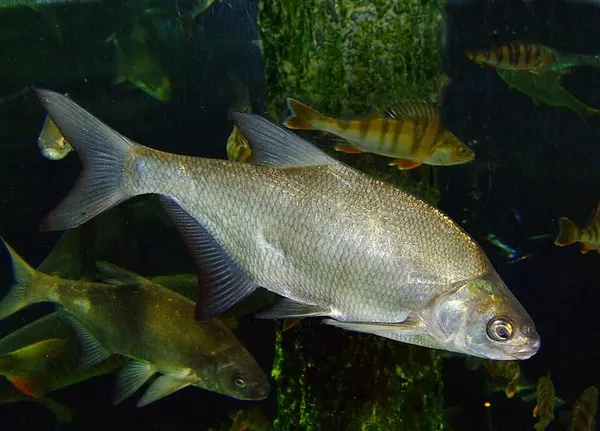
Bream live in shoals and feed on the bottom, rooting through the silt. When a shoal finds groundbait, it stays put for hours, so bream fishing is mostly about bringing the shoal in and keeping it there.
Unlike Prussian carp, bream respond well to a bigger bed of groundbait put in at the start, and they bite most reliably at dusk and at night. The general feeder guide covers the basic tackle; here are the differences that matter for bream.
Species: Bream
What you need
- Rod: a 3.6-4.2 m feeder rod with a medium action, for distances of 30-70 m; finer tips on lakes, stiffer ones on rivers.
- Reel: size 4000-5000, with a long spool for casting a long way.
- Line: 0.10-0.12 mm braid with a shock leader at range; 0.20-0.22 mm monofilament close in and on rivers.
- Rig: a paternoster loop or a running rig, a 30-60 g feeder (heavier on rivers), a 60-120 cm hooklength of 0.12-0.16 mm and a size 12-16 hook.
- Accessories: a catapult for the initial feed, a rest with a front bar, a chemical light on the tip for night fishing, and a keepnet only where you're allowed to keep fish.
Baits
- Worms and maggots, on their own or together on the hook: the most reliable baits for bream.
- Sweetcorn, soft pellets and paste, especially on lakes where the fish are used to them.
- Dark groundbait with a sweet flavour (vanilla, caramel), mixed with maggots, chopped worms, corn and cooked hemp.
When to fish
- From spring until autumn; on natural waters, after the closed season.
- The best times are dusk, night and dawn; during the day, in overcast weather with a light wind.
- In winter, on ice-free water, bream hold deep in tight shoals: very little groundbait and small baits.
Where are you fishing
- Large lakes, reservoirs, arms of the Danube and slow rivers, over a firm silt bottom.
- In 2-6 m of water: channels on the lake bed, the edges of holes and the plateaus in front of them.
- Small bubbles rising to the surface and coloured water over the groundbait often show a feeding shoal.
Step by step
- 1
Find the depth. With an empty feeder, count the seconds to the bottom in several directions and pick the edge of a hole or a channel on the bottom.
- 2
Set the distance. Put the line in the reel's line clip and keep your direction using a marker on the far bank.
- 3
Put in the initial feed. Bream respond to more groundbait: 10-15 full feeders emptied quickly on the same spot or, at short range, 8-12 balls of groundbait thrown by hand or with a catapult.
- 4
Cast with a long hooklength. Hook 2-3 maggots or a piece of worm and cast to the clip; an 80-120 cm hooklength lets the bait fall slowly and naturally.
- 5
Read the bite. Bream usually give slow bites: the tip pulls round gently and steadily or, when the fish lifts the bait, it drops back. Strike with a long sweep, not a jerk.
- 6
Hold the shoal. Recast every 5-10 minutes with a full feeder; if the bites tail off, put in a few full feeders one after another so the shoal doesn't move off.
- 7
Play it slowly. Bream resist mainly with their deep, flat body: bring the fish in steadily, without rushing, and net it away from the groundbait so you don't spook the shoal.
Common mistakes
- Too little groundbait at the start: a shoal of bream will swim past an empty swim.
- A hooklength that's too short or too thick: the bream feel the resistance and drop the bait.
- Striking too fast, at the first trembles of the tip.
- Noise and playing fish over the groundbait: the shoal gets spooked and leaves.
- Packing up before dusk, just when the bream start to feed.
Rules on natural waters
Bream
Minimum size: 25 cm
Species closed season: none, only the general closed season
General closed season: 9 April - 7 June (the periods differ on border waters and in the Danube Delta)
Daily limit: At most 5 kg of fish per day, or a single fish if it's over 5 kg.
The rules above are for natural waters (rivers, lakes, the Danube), where you also need a permit. On a private lake the lake's rules apply: many are catch & release or have their own limits.
For information only, not guaranteed legal advice. There are many local exceptions (Danube Delta, border waters, catch-and-release sections) not covered here. Always check the official ANADSPA (formerly ANPA) source before fishing.
Frequently asked questions
How much groundbait should I put in for bream?
More than for Prussian carp: 1-2 kg of dampened groundbait with particles (maggots, corn, hemp) at the start, then a full feeder on every cast. In cold water, halve the amounts.
Why do I miss bream on the strike?
Usually you're striking too early or the hook is too big. Wait for a clear bite, lengthen the hooklength and drop down to a size 14-16 hook.
Can I fish for bream with a float?
Yes, close in or on rivers, with a sliding float or a waggler and the bait on the bottom. Beyond 25-30 m, the feeder is more accurate.
What is the minimum size for bream, and when is the closed season?
In natural waters, the legal minimum size is 25 cm; smaller fish must be released. The general closed season also applies on natural waters: 9 April - 7 June.
Step-by-step guides
- Rig guide: Feeder with anti-tangle sleeve / loop (paternoster)
- Groundbait and recipes: All-round feeder groundbait (bream, Prussian carp)
- Groundbait and recipes: Particles: prepared maize and hemp
- Fishing knots: Figure 8 loop (double loop)
Fishing for bream by county
Find where to fish in the RoFish app
The map of fishing lakes and public waters across the country, the species filter, the rules of every spot and “Am I allowed to fish?” for the day you pick are in the RoFish app, on your phone.
Other fishing techniques
- Feeder fishing
- Prussian carp on the float
- Ice fishing
- Homemade groundbait
- Carp on the method feeder
- Carp on boilies
- Spinning for pike
- Zander on the jig
- Perch on the micro-jig
- Trout on spinners
- Wels catfish with the clonk
- Spinning for chub
- Asp on crankbaits
- Barbel on the feeder
- Tench on the float
- Fishing from a boat
- Pike on fish baits
- Perch on the drop shot
- Fly fishing
- Catfish from the bank