Barbel on the river: heavy feeder and rigs for the current
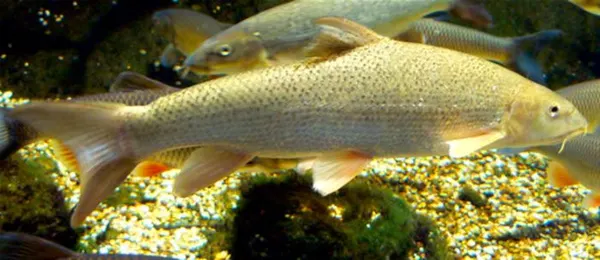
The barbel is a fish of clean rivers with gravel beds. It holds on the bottom, in the current, and feeds on larvae, worms and small crayfish, which it finds with the barbels around its mouth.
On rivers you catch it on a heavy feeder: the bait lies still on the bottom, in the current, while the groundbait from the feeder draws in fish from downstream. It's one of the hardest-fighting river fish, so your line and drag have to hold.
Species: Barbel
What you need
- Rod: a 3.6-3.9 m heavy feeder rod for 80-150 g feeders and more, with stiff tips; or a light carp rod.
- Reel: size 4000-5000, with a strong, smooth drag.
- Line: 0.25-0.30 mm monofilament, resistant to abrasion on stones.
- Rig: a 60-200 g feeder, depending on the current, on a running rig; a 30-60 cm hooklength of 0.18-0.22 mm and a strong size 8-14 hook.
- Accessories: a tall rest to keep the rod tip high, a landing net with a long handle, and boots or waders for stony banks.
Baits
- Maggots and worms, in a bunch on the hook: the classic barbel baits.
- Cubes of hard cheese and 8-12 mm pellets, on the hook or on a hair.
- Sticky groundbait that stays in the feeder until it reaches the bottom, with cooked hemp and maggots.
When to fish
- From late spring until autumn; the best months are summer and early autumn, when the water is warm.
- Evening, night and morning; during the day, when the water is slightly coloured after a little rain.
- When the river is high and coloured after heavy rain, look for the slacker water near the bank.
Where are you fishing
- Hill and lowland rivers with gravel and sand beds, and the Danube, along its stony banks.
- The head and tail of pools, the deeper water behind weirs and boulders, and the current along undercut banks.
- Note: in winter (1 January - 15 March and 1 November - 31 December), fishing is banned within 250 m upstream and downstream of bridges with piers in the riverbed, and within 250 m upstream of reservoir dams.
Step by step
- 1
Choose your swim. Look for a stretch with moderate flow and a gravel bed, downstream of a weir or a big boulder, where the water deepens.
- 2
Choose the feeder. The feeder has to hold bottom: if it rolls downstream, use a heavier one; if it only just holds, it's right.
- 3
Cast upstream. Cast slightly upstream and let the line tighten: the current settles the feeder on the bottom and the groundbait trickles downstream, towards the fish.
- 4
Raise the rod tip. Set the rod with the tip high so as little line as possible is in the water, and tighten up until the tip has a steady bend.
- 5
Feed steadily. Recast every 5-10 minutes to the same spot: a constant trail of groundbait and hemp brings the barbel up from downstream.
- 6
Strike at the sudden bite. A barbel wrenches the tip down and bolts; sometimes the tip springs back suddenly when the fish dislodges the feeder. Lift the rod firmly.
- 7
Play it in the current. Barbel use the current and head for the stones: keep the rod high, let the drag work and bring the fish to the bank without forcing it.
- 8
Release it properly. After a long fight in the current, hold the barbel in slack water, head upstream, until it swims off on its own.
Common mistakes
- A feeder that's too light, which rolls and carries the bait somewhere else.
- Line that's too thin for the stones and for a powerful fish.
- Groundbait that's too loose and empties from the feeder before it reaches the bottom.
- Holding the rod low: the current pushes on the whole line and moves the rig.
- Releasing the barbel straight into strong current before it has recovered.
Rules on natural waters
Barbel
Minimum size: 27 cm
Species closed season: none, only the general closed season
General closed season: 9 April - 7 June (the periods differ on border waters and in the Danube Delta)
Daily limit: At most 5 kg of fish per day, or a single fish if it's over 5 kg.
The rules above are for natural waters (rivers, lakes, the Danube), where you also need a permit. On a private lake the lake's rules apply: many are catch & release or have their own limits.
For information only, not guaranteed legal advice. There are many local exceptions (Danube Delta, border waters, catch-and-release sections) not covered here. Always check the official ANADSPA (formerly ANPA) source before fishing.
Frequently asked questions
What feeder weight should I use on a river?
Enough to hold bottom: on small rivers 60-90 g is usually enough, while on big rivers and the Danube you often need 120-200 g. A flat feeder holds better in the current than a round one.
Can I catch barbel on the float?
Yes, on smaller, clear rivers, with a stick float run down with the current and the bait just off the bottom, over gravel. On big, deep water, the feeder is more reliable.
What is the minimum size for barbel, and when is the closed season?
In natural waters, the legal minimum size is 27 cm; smaller fish must be released. The general closed season also applies on natural waters: 9 April - 7 June.
Step-by-step guides
- Rig guide: Feeder with anti-tangle sleeve / loop (paternoster)
- Groundbait and recipes: All-round feeder groundbait (bream, Prussian carp)
- Groundbait and recipes: Particles: prepared maize and hemp
- Releasing fish properly: The golden rules
Fishing for barbel by county
Find where to fish in the RoFish app
The map of fishing lakes and public waters across the country, the species filter, the rules of every spot and “Am I allowed to fish?” for the day you pick are in the RoFish app, on your phone.
Other fishing techniques
- Feeder fishing
- Carp on the method feeder
- Carp on boilies
- Spinning for pike
- Zander on the jig
- Perch on the micro-jig
- Trout on spinners
- Prussian carp on the float
- Wels catfish with the clonk
- Spinning for chub
- Asp on crankbaits
- Bream on the feeder
- Tench on the float
- Ice fishing
- Fishing from a boat
- Homemade groundbait
- Pike on fish baits
- Perch on the drop shot
- Fly fishing
- Catfish from the bank