Wels catfish from the bank: the static rig and baits
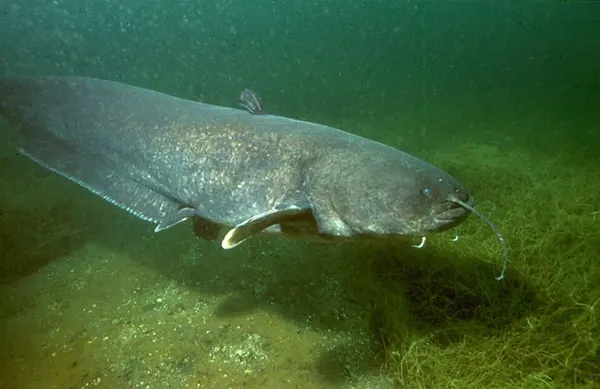
The wels catfish is the biggest fish in our waters and hunts mainly at night, along banks, holes and fallen trees. From the bank you catch it static fishing: a big natural bait held above the bottom by a float, and a rig that can stand up to a fish of several dozen kilos.
It's a waiting game, with rods on rests, bite alarms and long nights. What counts is the spot, fresh bait and tackle with no weak points.
Species: Wels catfish
What you need
- Rod: a powerful 2.7-3.3 m catfish rod, for 150-300 g leads.
- Reel: a big reel with a strong drag, or a multiplier.
- Line: 0.35-0.50 mm braid, abrasion-resistant.
- Rig: a 150-300 g running lead (a grip lead in current), a strong swivel, a 50-80 cm Kevlar or heavy braid hooklength, a 4/0-8/0 hook or a circle hook, and a catfish float to keep the bait up.
- Accessories: a solid rest, a bite alarm, a head torch, a thick glove and a large unhooking mat.
Baits
- Big bunches of worms and leeches: the classic baits from the bank.
- Fish baits, live or dead, where the rules allow, of non-protected species with no legal minimum size.
- Large halibut pellets and pieces of squid, especially on waters where the catfish are used to them.
When to fish
- Summer and early autumn, when the water is warm; activity drops as the water cools.
- Night and changes of light, evening and dawn; in warm, oppressive weather, before a storm, catfish are often very active.
Where are you fishing
- The Danube and its arms, the big rivers and the large reservoirs.
- Holes close to the bank, steep banks, fallen trees, groynes, canal mouths and the eddies behind obstacles.
- On private lakes with catfish, only where the rules allow catfish fishing and the baits you use.
Step by step
- 1
Choose your swim. Look for a hole or a steep bank with deep water close by and snags around, but leave yourself room to play the fish, with no branches in the way.
- 2
Prepare the rig. Thread the line through the anti-tangle tube and the lead, add the bead and tie on the swivel; tie the hooklength to the hook and put the catfish float on the hooklength, 20-30 cm from the hook, so the bait sits above the bottom.
- 3
Bait up. Put on a big bunch of worms or the bait fish; the bait should move above the bottom, held up by the float.
- 4
Cast or take the rig out. Cast to the edge of the hole or, where allowed, take the rig out by boat; put the rod on a solid rest, with the drag set or the free-spool engaged.
- 5
Wait for the bite. A catfish may first give a few small knocks, then set off suddenly and pull down: pick up the rod and strike firmly; with a circle hook, don't strike, just tighten up gradually.
- 6
Play and land it. Keep the rod high and let the drag work; when the catfish is tired, grip it by the lower jaw with a glove and hold it horizontally on the wet mat.
Common mistakes
- Gear too weak for a fish weighing tens of kilos.
- Drag screwed down all the way: the line snaps on the first run.
- Rods left unattended on weak rests: a catfish can pull them into the water.
- Old bait that no longer gives off scent or moves.
- Holding a big catfish vertically, hanging by its mouth.
Rules on natural waters
Wels catfish
Minimum size: 50 cm
Species closed season: none, only the general closed season
General closed season: 9 April - 7 June (the periods differ on border waters and in the Danube Delta)
Daily limit: At most 5 kg of fish per day, or a single fish if it's over 5 kg.
The rules above are for natural waters (rivers, lakes, the Danube), where you also need a permit. On a private lake the lake's rules apply: many are catch & release or have their own limits.
For information only, not guaranteed legal advice. There are many local exceptions (Danube Delta, border waters, catch-and-release sections) not covered here. Always check the official ANADSPA (formerly ANPA) source before fishing.
Frequently asked questions
What is a catfish float?
A small float (or a balloon) placed on the hooklength, close to the hook, that holds the bait up above the bottom, where the catfish finds it more easily. The rig is described step by step in the catfish rig guide.
Can I fish for catfish at night from the bank?
On public waters, night fishing isn't generally banned by law, but the association's or the park's rules may ban it; on private lakes, the lake's rules decide. In the RoFish app you can see for each lake whether night fishing is allowed.
What is the minimum size for wels catfish, and when is the closed season?
In natural waters, the legal minimum size is 50 cm; smaller fish must be released. The general closed season also applies on natural waters: 9 April - 7 June.
Step-by-step guides
- Rig guide: Catfish ledgering (fixed rig with a heavy lead)
- Releasing fish properly: Wels catfish
Fishing for wels catfish by county
Find where to fish in the RoFish app
The map of fishing lakes and public waters across the country, the species filter, the rules of every spot and “Am I allowed to fish?” for the day you pick are in the RoFish app, on your phone.
Other fishing techniques
- Wels catfish with the clonk
- Fishing from a boat
- Feeder fishing
- Carp on the method feeder
- Carp on boilies
- Spinning for pike
- Zander on the jig
- Perch on the micro-jig
- Trout on spinners
- Prussian carp on the float
- Spinning for chub
- Asp on crankbaits
- Bream on the feeder
- Barbel on the feeder
- Tench on the float
- Ice fishing
- Homemade groundbait
- Pike on fish baits
- Perch on the drop shot
- Fly fishing